You’ll often spot it paired with cherry blossoms, bento boxes, origami, and teacup emojis to build a soft, spring-forward aesthetic. It shows up on Tokyo travel posts, crafting/DIY reels, and cosplay captions, and doubles as a flirty wink: “we’d look cute on a shelf together.” In meme speak, it’s code for rigid formality, serene stillness, and picture-perfect composure—statuesque, but irresistibly cute.
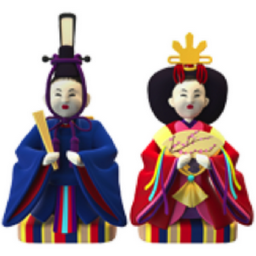
These are the classic Hinamatsuri dolls—emperor and empress for Girls’ Day—serving Heian-era power-couple energy. On Apple platforms, they’re seated side by side on a vivid red stand with a gold folding screen; the emperor sports a black kanmuri and grips a baton-like shaku, while the pink-clad empress holds a fan. Tiny dot eyes, modest smiles, delicate kimonos, and impeccable posture give off major “look, don’t touch” museum vibes. It’s tradition-rich, adorable, and instantly familiar if you’ve seen spring displays or gift-shop windows in Japan.
Online, people drop this emoji to cue Japanese-culture vibes, Girls’ Day posts (March 3), or any look that’s “kawaii yet refined.” It also works as a duo badge—best friends, couple goals, twinning outfits, or the two leads you’re shipping. Used dryly, it reads as “we’re here just to decorate” or “smiling politely through the chaos,” and it can feel calm, ceremonial, and a touch nostalgic—like your group chat all dressed up and seated by the place cards.
Definition
The Japanese Dolls emoji is a symbol for the Hinamatsuri (Girls' Day or Doll's Day) in Japan. Ornamental dolls representing the Imperial Family in traditional attire. The dolls include the emperor, empress and the people that typically surround them (the royal court). Celebrated on March 3rd, Doll's Day is the day to pray for young girls and their well being. Doll's Day is not considered an official holiday of Japan.
Disqus Leave a comment!
Emoji History The emoji code/ image log of changes.
This emoji was part of the proprietary / non-standardized emoji set first introduced by Japanese carriers like Softbank. These emojis became part of the Apple iPhone starting in iOS 2.2 as an unlockable feature on handsets sold in English speaking countries.
In iOS 5 / OSX 10.7, the underlying code that the Apple OS generates for this emoji was changed.
Japanese dolls of a couple dressed in traditional robes and hair fashion, they are kneeling down. Japanese Hinamatsuri. Girl power! iEmoji old name: Traditional Japanese Couple
Proposed Unicode Information & Notes
Unicode Category
Artifacts
Unicode Subcategory
Celebration Symbols
Names & Annotations
JAPANESE DOLLS Old name: GIRLS DOLL FESTIVAL * Japanese Hinamatsuri or girls' doll festival Temporary Notes: 雛祭り: Japanese Hinamatsuri
Symbol Information
U+1F38E proposed
Proposal Identifier
e-519
Character Mapping/Crosswalk Notes
DoCoMo
[ひな祭り]
KDDI
#477 雛祭り 「雛祭ri」 U+EAE4 SJIS-F3B8 JIS-7A3A
Softbank
#310 #old403 ひな祭り 「hina祭ri」 U+E438 SJIS-FB78
Emoji Character Encoding Data
Emoji Code Version
iOS 5 - Current
UTF-8 Unicode Character(s)
🎎
UTF-8 Character Count
1
Character(s) In Input
AppleColorEmoji Font (available in OSX/iOS)
🎎
Decimal HTML Entity
🎎
Hexadecimal HTML Entity
🎎
Hex Code Point(s)
1f38e
Formal Unicode Notation
U+1F38E
Decimal Code Point(s)
127886
UTF-8 Hex (C Syntax)
0xF0 0x9F 0x8E 0x8E
UTF-8 Hex Bytes
F0 9F 8E 8E
UTF-8 Octal Bytes
360 237 216 216
UTF-16 Hex (C Syntax)
0xD83C 0xDF8E
UTF-16 Hex
d83cdf8e
UTF-16 Dec
55356 57230
UTF-32 Hex (C Syntax)
0x0001F38E
UTF-32 Hex
01F38E
UTF-32 Dec
127886
Python Src
u"\U0001F38E"
PHP Src
"\xf0\x9f\x8e\x8e"
C/C++/Java Src
"\uD83C\uDF8E"
Emoji Character Encoding Data (equivalent or similiar)